| |
Duchampian News & Reviews
from institutions, scholars and fans
• Happy Birthday Berenice Abbott
BERENICE ABBOTT (1898–1991)
"Berenice Abbott can be considered the photographer of New York City.
A revolutionary documentary photographer, Abbott was born in
Springfield, Ohio, in 1898, and studied for one year at Ohio State
University, Columbus, before moving to New York in 1918 to study
sculpture. While in New York, Abbott met Marcel Duchamp and Man
Ray, two of the founders of the Dada movement"" more |
• Duchamp in Buenos Aries : Exhibition
"De la estadía porteña de nueve meses de Marcel Duchamp es
relativamente poco lo que se sabe y gracias a la creación de unas
pocas obras y a una decena de cartas."" more
|
• Marcel Duchamp: A work that is not a work "of art"
by Lee Wells
MAM – MUSEU DE ARTE MODERNA DE SÃO PAULO
Curator: Elena Filipovic
15 July - 21 September
"On the day marking its 60th birthday, July 15 (Tuesday), the Modern
Art Museum of São Paulo presents Marcel Duchamp: A work that is not a
work 'of art '. The exhibition takes its title from a question that
Marcel Duchamp wrote down one day in 1913: "Can one make works that
are not 'of art'?" more
|
• Picabia, Man Ray, Duchamp, des hEROS
by L. Brandon Krall
|
| "Man Ray, The Rope Dancer Accompanies Herself with Her
Shadows, 1916. Oil on Canvas, 132.1 x 186.4 cm. Courtesy of the
Museum of Modern Art, New York. © ADAGP, Paris and DACS, London, 2008."Image source |
"Review: Duchamp, Man Ray, Picabia was on view at the Tate Modern,
London in May. It traveled to the Museu Nacional d'Art de Catalunya,
Barcelona, where is on view from June 19 to September 21." more
|
• Elsa Schiaparelli, Surrealist Star
by David Motta
"Elsa Schiaparelli was an influential Italian fashion designer. Along
with Coco Chanel, she dominated fashion between the two World Wars.
Starting with knitwear, her designs were heavily influenced by
Surrealists like her collaborator Salvador Dali...Elsa began working
for Gaby [Picabia, ex-wife of French Dadaist artist Francis
Picabia] who introduced her to artists such as Marcel Duchamp and
Man Ray." more
|
• Machinima and Up and Coming
by The Recycled Cinema
"Most of my reading and writing right now is concerned with how
Surrealists theorized found objects. The principal figures I'm
looking at, Joseph Cornell and Marcel Duchamp were not officially
inaugurated by Andre Breton into the Surrealist group but made some
of the most interesting contributions to found object art with their
assemblages and readymades." more
|
• 'ALL ARTISTS ARE NOT CHESS PLAYERS" :
Allan Savage on Duchamp, Man Ray, Picabia
by Michael Leonard
|
1911. Oil on canvas 108 x 101 cm. The Philadelphia Museum of Art, Philadelphia, PA, USA.
Image source |
"For Marcel Duchamp, chess was almost everything.
As his friend, the author Henri-Pierre Roché,
noted: "He needed a good chess game like a baby
needs his bottle." It featured throughout his art
career, from his early painting Portrait of Chess
Players (1911) to Reunion, the performance/chess
game he staged with John Cage in 1968 on an
electronically prepared board." more
|
• Jeu d'échecs avec Marcel Duchamp
by harry wanders
"This film records an in-depth interview with Duchamp which took
place five years before his death, at the time of his first ever
one-man show (at the Pasadena Art Museum). It records for posterity
Duchamp talking about his life, his ideas on art, why he chose to
continue living in America after fleeing France in 1915, and why he
virtually abandoned his work as an artist in 1923." more
|
• Machinima
and Up and Coming
work by The Recycled Cinema
"Most of my reading and writing right now is concerned with how
Surrealists theorized found objects. The principal figures I'm
looking at, Joseph Cornell and Marcel Duchamp were not officially
inaugurated by Andre Breton into the Surrealist group but made some
of the most interesting contributions to found object art with their
assemblages and readymades." more
|
• Davy between painting, photography
by Alex Supartono, Contributor, Jakarta
|
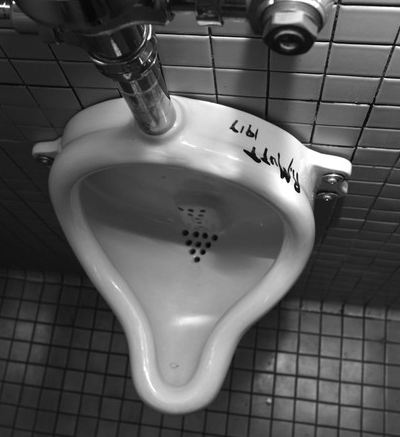
| Photo credit for Duchamp's "Fountain" 1917, was given to Alfred
Steiglitz ...but there is no negative or other record other than
Steiglitz's mention of it in a letter. Image source |
"In his letter to Alfred Steiglitz -- the father of American
photography -- Marcel Duchamp wrote: "You know exactly how I feel
about photography. I would like to see it make people despise
painting until something else will make photography unbearable." The
letter is dated May 22, 1922." more
|
• Duchamp: "Sixteen Miles of String" (1942)
Posted by Wrong
"Duchamp bought 16 miles of string, of which only one mile was used,
to prepare an entanglement in which the visitor experienced
difficulties in finding his way to the paintings, a metaphor for the
difficulties which the layman often encounters in the attempt to
understand modern painting"
more
|
• Ducham en Barcelona
by A-Desk Media
"See video of new "Duchamp, Man Ray, Picabia" exhibition in Spain more
|
• Duchamp, Man Ray, Picabia Exhibit at Museo Nacional D'Art de Catalunya
by Art Knowledge News
"BARCELONA - This exhibition aims to chart the artistic and personal
relationships of three of the great figures in early
twentieth-century art, Marcel Duchamp, Man Ray and Francis Picabia.
Together they created the Dada movement in New York during the First
World War, and, unusually within the history of modern art, they
remained friends, with periods of varying intensity, throughout their
lives. On view 26 June through 21 September, 2008." Visit Museo Nacional D'Art de Catalunya at : http://www.mnac.es
more
|
• Wee exhibit, big scandal
by Angela Bennie
|
"First turn... a replica of Mercel Duchamp's original
'readymade' Bicycle Wheel."
Image source |
"Which is perhaps why Carolyn Christov-Bakargiev, the curator of the
2008 Biennale of Sydney, has placed Duchamp's Bicycle Wheel right at
the centre of her huge line-up of contemporary art in this year's
Biennale program, to which she has attached the slogan "Revolution -
Forms that Turn" as her overriding theme. 'A revolution is a turn and
a return,' she says. ' It is also a sudden shift in perspective, a
turning of perspectives, which is what Duchamp has done. So with this
Biennale I am opening up the meaning of the word revolution.'" more
|
• Marsden Hartley exhibit at Amon Carter shows darker vision of the West
By CHARLES DEE MITCHELL
|
"Painting, Number 5," by Marsden Hartley, 1914-5, oil on canvas, 39 1/2 by 31 3/4 inches, Whitney Museum of American Art Image source |
"[Marsden] Hartley returned to New York City in 1919, where he became
an unlikely member of the Société Anonyme, the avant-garde group
headed by Marcel Duchamp, Man Ray and Katherine Dreier. Hartley was
attracted to the freedom of the group, but he was at heart a much
more traditional artist and he lasted only seven months." more
|
• PRIX MARCEL DUCHAMP: A COLLECTORS' PRIZE
By ArtSlant team
|
| On June 24, 2008, the exhibition of Tatiana Trouvé, the
winner of the 2007 Prix Marcel Duchanp, opens at the Centre Pompidou. Image source |
"The Marcel Duchamp Prize was created in 2000 by the ADIAF,
(Association for the international distribution of French art), the
largest group of private and amateur contemporary art collectors in
France, as an initiative, amongst others, for promoting French
artists internationally. Its aim is to encourage all new art forms
that stimulate contemporary creation, and to give recognition to a
promising artist living in France and working in the domain of the
visual and plastic arts." more
|
• Duchamp pipe for Enrico Donati
By Marcin_Pro's blog
|
| Pipe carved for Marcel Duchamp by his friend, surrealist painter, Enrico Donati Image source |
"Marcel Duchamp carved a wooden pipe for Donati.
Enrico Donati was a close friend of Marcel Duchamp, as well as a fellow surrealist painter.
Donati says that there is no story behind this pipe and that it was given to him by Duchamp as a token of their friendship." more
|
•
Marcel Duchamp's famous statement on creativity
By Muindi
|
| Marcel playing chess. he always spoke of his concerns for
"posterity." The spectator was half of the creative process according to Duchamp
Image source |
"Marcel Duchamp, "The Creative Act" statement :
"Let us consider two important factors, the two poles of the creation
of art: the artist on the one hand, and on the other the spectator
who later becomes the posterity...
All in all, the creative act is not performed by the artist alone;
the spectator brings the work in contact with the external world by
deciphering and interpreting its inner qualification and thus adds
his contribution to the creative act. This becomes even more obvious
when posterity gives a final verdict and sometimes rehabilitates
forgotten artists." more
|
• Duchamp's concept "inframince"
By whichby
"Aesthetic concept developed by Marcel Duchamp for whom it generally
characterised a thickness ("épaisseur"), a separation, a difference,
an interval between two things, in general little perceptible. The
inframince qualifies a distance or a difference that you cannot
perceive, but that you can only imagine. The best example of it, is
the 'infra-mince separation between the bang of a gun (very near) and
the mark of appearance of the mark of the bullet on the target.' " more from Marc Biétry
|
• Duchamp en Buenos Aires
By Marcelo Gutman
"This DVD is a strictly limited edition catalogue of 1.000. Each numbered and hand signed by the artist, curator and researcher Marcelo Gutman. You can see a hand made video of the exhibition here [on YouTube] "
|
• Marcel Duchamp's masterwork
By Timothy B. Buckwalters
|
Photographs of the doors to Duchamp's last studio at at 80 E. 11th Street in NYC by Denise Brown Hare.
Image source |
"In 1969's Art Bulletin, the
Philadelphia Museum of Art's newsletter,
[the late] Anne d'Harnoncourt and Walter Hopps offered the history of
and an analysis for Marcel Duchamp's masterwork,
Etant
Donnés...
Also included in the Bulletin was an amazing backstage look at the
process. Between 1965 and 1968, Ducchamp's studio was housed in suite
40 at 80 E. 11th Street in NYC, across from a union office. Denise
Brown Hare visited him and captured the piece in progress."
more
|
• The Dada Baroness
By Elaine's T* Art Blog
|
""She's not a futurist," said Marcel Duchamp of Baroness Elsa. "She is
the future." "Portrait of Marcel Duchamp, c.1920, Baroness Elsa von Freytag-Loringhoven, Photo: Charles Sheeler"
Image source |
"One of the completely forgotten names--but a name well-known among
the literati of the 1920's--is that of Baroness Elsa von
Freytag-Loringhoven (1874-1927). This enigmatic, gender-bending
artist, a friend and collaborator of Duchamp, Man Ray and Djuna
Barnes, is considered by art historians to be the first New York Dadaist."
more
|
• He was 'Nouveau' when it was new
By Rachel Donadio
|
"An originator of the Nouveau Roman, or New Novel, and the
screenwriter for Alain Resnais's 1961 cult film "Last Year at
Marienbad," Robbe-Grillet was the very model of a postwar avant-gardist."
Image source |
Robbe-Grillet and the other so-called New Novelists, including
Michel Butor, Nathalie Sarraute and Claude Simon, wanted to do in
literature what others had done in art just as Marcel Duchamp had
deconstructed human motion in "Nude Descending a Staircase" and the
Abstract Expressionists had valorized gesture, the movement of a
brush stroke itself, over representation. Robbe-Grillet believed that
writing should reveal the archaeology of its own construction, should
depict a mind unfolding its thoughts over
time.
more
|
• The Société Anonyme: Modernism for America
Organized by the Yale University Art Gallery
Exhibition Venues
• Hammer Museum, Los Angeles, CA: April 23–August 20, 2006
• The Phillips Collection, Washington, DC: October 14, 2006–January 21, 2007
• Dallas Museum of Art, TX: June 10–September 16, 2007
• Frist Center for the Visual Arts, Nashville, TN: October 26, 2007–February 3, 2008
• Yale University Art Gallery, New Haven, CT: Fall 2010
See interactive online
|
• Sterne and Steinberg: Critics Wit
featured at The Menil Collection
|
"Hedda Sterne and Saul Steinberg." Circa 1944-45. From the private
collection of Hedda Sterne and the estate of George Platt Lynes. Image source |
"Friendly with Duchamp, she [Hedda Sterne] exhibited alongside
Pollock and Newman, drank with de Kooning and held glorious debates
with Harold Rosenberg. Greenberg chronicled her and "Life" magazine
captured her several times, the most famous photo of which is Art
History-101 iconic. She refused to be classified stylistically or put
"in a box." During her 70-year career she appropriated from
Surrealism, Abstract Expressionism and any other canon that served
her." more
|
• Elsa Schiaparelli, Surrealist Star
by David Motta
"Elsa Schiaparelli was an influential Italian fashion designer. Along
with Coco Chanel, she dominated fashion between the two World Wars.
Starting with knitwear, her designs were heavily influenced by
Surrealists like her collaborator Salvador Dali...Elsa began working
for Gaby [Picabia, ex-wife of French Dadaist artist Francis
Picabia] who introduced her to artists such as Marcel Duchamp and
Man Ray." more
|
• Duchamp: A Game of Chess
by Novis.Liber
|
Marcel Duchamp: A Game of Chess
(Jeu d'échecs avec Marcel Duchamp)
Image source |
"This film records an in-depth interview with Duchamp which took
place five years before his death, at the time of his first ever
one-man show (at the Pasadena Art Museum). It records for posterity
Duchamp talking about his life, his ideas on art, why he chose to
continue living in America after fleeing France in 1915, and why he
virtually abandoned his work as an artist in 1923." more
|
• Releated works: marcel duchamp, Harold E. Edgerton
by Clemens Winkler
"Harold Eugene “Doc” Edgerton (April 6, 1903 – January 4, 1990) was a professor of electrical engineering at the Massachusetts Institute of Technology. He is largely credited with transforming the stroboscope from an obscure laboratory instrument into a common device. For example; today, the electronic flash is completely associated with the field of photography." more
|
• Man Ray: Avant-Garde Alchemist
by The Artist
|
Man Ray (1890-1976)
"To create is divine, to reproduce is human."
Image source |
"So, how does someone named Emmanuel Radnitzky end up with a stylish
moniker such as 'Man Ray'? Well, his family surname was changed to
'Ray' in 1912 at the suggestion of Man Ray's brother. The family
surname was changed as a reaction to the anti-Semitism that was
rampant in Brooklyn, New York at the time. Emmanuel was called
'Manny"'for short and Emmanuel eventually shortened his nickname to
'Man' and added that to his new surname 'Ray' He would gradually
begin to use his new names as one single combined name, 'Man Ray.'" more
|
• Miller And The Matisses
by Cosmodemonic Telegraph Company: A Henry Miller Blog
|
"A illustrated portrai of Alexina made by Henri Matisse in 1938."
Image source |
"Alexina Sattler (1906-1995) entered into the Matisse family through
her marriage to Pierre Matisse [8]. The American-born
artistnicknamed "teeny" because of her petite staturewent to Paris
in 1921 to pursue her artistic vocation. She married Pierre in
1929...She divorced Pierre in 1949, and later married Marcel Duchamp
in 1954, although she had originally met him in 1923." more
|
• Pompidou Centre apologizes for broken artwork
|
"Visitors at a 2005 exhibit at Paris' Pompidou Center. The Pompidou
Centre said Thursday it had apologized to US contemporary artist
Corey McCorkle after one of his artworks broke when it fell to the
floor of the Paris museum."(AFP/File)
Image source |
"The Pompidou Centre had promised to take additional measures to
prevent damage to artworks after two contemporary works from its Los
Angeles: 1955-1985 exhibition were broken in September 2006.That
incident followed an attack in January 2006 during which a man used a
hammer to damage an upturned urinal called "Fontaine" (Fountain) by
Marcel Duchamp." more
|
• Surrealist Manifesto' comes up for auction in Paris
|
Extracts of original manuscripts by surrealist author Andre Breton
and part of the "Surrealist Manifesto" are exhibited at Sotheby's
auction house in Paris on May 16. The only known complete copy of the
"Surrealist Manifesto," the 21-page document that defined one of the
great art movements of the 20th century, is to be auctioned on May 21.
Image source |
"The only known complete copy of the "Surrealist Manifesto," the
21-page document that defined one of the great art movements of the
20th century, is to be auctioned in Paris...Penned by Andre Breton
and published in 1924, it comes from the collection of the late
Simone Collinet, his first wife, and is valued by Sotheby's at
300,000 to 500,000 euros (468,500 to 780,800 dollars)..." more
|
• Stephanie Delacey and Luis Drayton by Marcel Duchamp
by Stephanie Delacey and Luis Drayton
|
Taken at the Duchamp/Picabia/Man Ray exhibition at the Tate Modern; 13/05/08. Photo: Stephanie Delacey.
Image source |
"Taken at the Duchamp/Picabia/Man Ray exhibition at the Tate Modern;
13/05/08. Photo: Stephanie Delacey..." more
|
• The surreal thing: Man Ray's Paris
by Carole Pope, National Post
|
The Port Royal metro station in Paris. Credit: Carole Pope
Image source |
"As an art groupie, I've always been a fan of the great Surrealist
artist Man Ray and wanted to immerse myself in the neighbourhoods
where he lived, created his art and socialized with friends who were
often the subject of his work..." more
|
• Catálogo Retrospectiva Duchamp Mary Sisler Collection
by Marcelo GUTMAN
• Metropolitan Museum Announces Master Photographer Exhibit in June
by ArtDaily.org
|
Duchamp Portrait by Man Ray
Image source: Rhonda Roland Shearer's Duchamp Collection |
"The exhibition concludes with the work of four artists who were
significant in transforming photography into a modern visual
language. The exhibition's photographs by Man Ray (1890–1976), for
example, will capture the broad creative scope of his work in the
1920s and 1930s, including portraits of fellow artists Marcel Duchamp
and Jean Cocteau; documentation of his own ephemeral sculptures; and
photographs that reveal his dynamic experimentation with the
plasticity of the medium through solarization, photograms, negative
prints, and film." ... more
|
• Pasadena Part II: Norton Simon Museum
by Acornucopia Project
" ...We went to the Norton Simon Museum to see the Marcel Duchamp Redux exhibition... It was smaller than I
expected but they had some good pieces on display. They had a set of
four "rotoreliefs" that were best viewed in person. These were motor
driven turntables that rotated an image to give the impression of a
form in movement. I had seen the still images in books (such as the
fish in a pond) but it was good to see them in motion." ... more
|
• Student research at Savannah College of Art and Design: Britt Kirmes' thesis statement about Duchamp
"Marcel Duchamp is one of the most influential artists of his time because of his unique approach to art, integration of art and life, and ability to provoke thought within the viewer." See her outline...
|
• The fountain drawings
by Mike Bidlo
|
Mike Bidlo. The fountain drawings, an installation
Image source |
"Mike Bidlo has concentrated his artistic energies on making a large number of drawings, each one different from the other, with Duchamp's masterpiece as their subject, using a multitude of brushes, pencils and media." ... more
|
• ELECTRACY
by ainanott
"Marcel Duchamp (Dada artist) altered the classic Mona Lisa originally created by Leonardo Da Vinci during the Italian Renaissance. .. From looking at these (Dada) artworks, some similarities have been related in the progression of electronic literacy and digital art. As we live in the midst of a 'Global Communication Revolution', information, communication and technology have become so important that it continues to change and alter aspects of our daily lives." ... more
|
• Video: Badiou, "Some Remarks Concerning Marcel Duchamp" at Tilton Gallery
by Farhang Erfani
• Surrealist Enrico Donati Dies at 99
by sanjoe
|
Marcel Duchamp and Enrico Donati (from left to right) at Yves Tanguy's house in Woodbury, CT, 1945 credit: toutfait.com
Image source |
"Enrico Donati, an Italian-born American painter and sculptor considered by many in the art world to be the last of the Surrealists, died at his home in Manhattan Enrico Donati (b.1909) was an American Surrealist painter and sculptor of Italian birth...he was clearly drawn to Surrealism. This was reinforced by meeting André Breton and coming into contact with Duchamp and the other European Surrealists in New York at the time." ... more
|
• Artwork Censored ...like Duchamp's urinal. Yale erred in banning Shvarts' art
by Seth Kim-Cohen
|
A controversial art exhibit will now have to be displayed along with a disclaimer.
(ABC News Photo Illustration)
Image source |
"....Unfortunately, the (Yale) University has banned her work from the Senior Project Show, making a first-hand encounter with Shvarts' work impossible. The University has decided not to allow the rest of us make up our own minds. I am considerably more troubled by their action than by hers. ..For the University to ban Aliza Shvarts' artwork, to deny the rest of us the opportunity to make up our own minds, is to abdicate this 'special responsibility.' The University should admit they have made a mistake and reinstate Shvarts' artwork. Seth Kim-Cohen is a lecturer in the History of Art Department." ... more
|
• Dada Magazine, Issues 1, 2, 3 (1917-1918)
" Appearing in July 1917, the first issue of Dada, subtitled Miscellany of Art and Literature, featured contributions from members of avant-garde groups throughout Europe, including Giorgio de Chirico, Robert Delaunay, and Wassily Kandinsky... Printed in newspaper format in both French and German editions, it embodies Dada's celebration of nonsense and chaos with an explosive mixture of manifestos, poetry, and advertisements - all typeset in randomly ordered lettering. Included is Tzara's "Dada Manifesto of 1918," which was read at Meise Hall in Zurich on July 23, 1918, and is perhaps the most important of the Dadaist manifestos." ... more
|
• The Western Round Table on Modern Art (1949) by Ubu.com
|
The Western Round Table on Modern Art in session
Image source |
"Participants included Marcel Duchamp, Frank Lloyd Wright, Arnold Schoenburg, Mark Tobey, Gregory Bateson. Organizer Douglas MacAgy writes, "The object of the Round Table was to bring a representation of the best informed opinion of the time to bear on questions about art today (1949)."... more
|
• Scathing Online Schoolmarm
Margaret Solton's response to Yale erred in banning Shvarts' art by Seth Kim-Cohen
|
Aliza Shvarts, Yale art student, speaking in New York earlier this month. (Photo: YouTube)
Image source |
"An art professor at Yale wrestles with the Aliza Shvarts controversy. He attempts to open with humor, but what he’s written sounds pompous and illogical. Do Yale students think professors are gods? Robots? All teachers have always been people. Why is this a compromised position? Is he saying that as a person I find students who film themselves bleeding out repeated induced abortions in bathtubs and then mounting the images as a show a little troubling, while as a teacher I find it okay?"... more
|
• That Ubu that you do
|
Unpublished poster of the meeting. This concert of electronic music was organized around a game of chess between Marcel Duchamp and John Cage at the Toronto Ryerson Institute (Canada) on March 5th, 1968.
Image source |
"(Alfred) Jarry's legacy was formalised posthumously in 1948 by the founding of the Collège de 'Pataphysique in Paris. Its constitution asserts that all people are 'pataphysicians whether they know it or not, but paid-up Collège members have included artists... Marcel Duchamp, Max Ernst, Jean Dubuffet... And its precepts have produced music more interesting and challenging than Maxwell's Silver Hammer.
"Duchamp created a number of musical compositions, many purely conceptual. But when Stephane Ginsburgh recorded Duchamp's 1913 opus Erratum Musical a few years back, he took into account Duchamp's observation that 'pataphysics involved "canned chance" and ensured all the piece's 88 piano notes were picked out in a random order with no emphasis on any one in particular"... more
|
• Duchamp's Brother Raymond Duchamp-Villon sculpture
|
The Horse (Le Cheval), 1914 (ca. 1930). Bronze and patina, 17 3/16 x 16 1/8 inches. Peggy Guggenheim Collection. 76.2553.25.
Image source |
"Raymond Duchamp-Villon's began work on the plaster original of The Horse, a composite image of an animal and machine, in 1914, finishing it on leaves from military duty in the fall. It was preceded by numerous sketches and by several other versions initiated in 1913. The original conception did not include the machine and was relatively naturalistic, as is evident in the early states of the small Horse and Rider of 1914. "... more |
• ...Ray, man! Man Ray Exhibition in Madrid
by paperhands
" "My mother told me I made my first man on paper when I was three", Man Ray wrote in his Self-portrait typed manuscript.
"Man Ray - Unconcerned But Not Indifferent" exhibition presents drawings, photographs, paintings, sculptures, personal objects, and images from the Man Ray Trust collection founded by the artist's wife, Juliet Browner in Long Island, New York. The exhibition at the Colecciones ICO in Madrid is comprised of nearly 300 items and it is the first one to place his art in relation to his personal objects such as the bowler hat and cane, or objects from his Rue de Ferou Studio in Paris." ... more |
• Chess musings
by
circletide on
Dichterische Fragmente
|
"It was Duchamp, wasn't it, that gave up his art, his projects, for chess? Perhaps not true, but I remember it so. Did Duchamp not talk of chess being the highest form of art because it is - in the most basic form - a visual representation of human thought, but also because it, as does life, contains rules, symbolism, sign structures, competitiveness, relationship...? Is it not also true that it cannot be commercialised like art?" ... more |
• In the Tate Collection : Marcel Duchamp:
The Bride Stripped Bare by her Bachelors Even, (The Green Box) 1934 [front cover]
|
| The Green Box Notes " Felt covered cardboard containing one colour plate and ninety-three paper elements"...source |
"In 1934 Marcel Duchamp - or more accurately his alter ego Rrose Sélavy - published in green felt covered boxes ninety-four loose notes relating to the development and function of his magnum opus The Bride Stripped Bare by her Bachelors Even, known familiarly as 'The Large Glass'... more |
• Todays Quote 04.18.08 by
michael ammerman
|
| Marcel Duchamp, 2003
Oil on canvas, 30 x 25 inches; Painting by Jacques Moitoret , see more art inspired by Duchamp at Francis M. Naumann Fine Art in New York...more |
"Art is like a shipwreck... it's everyman for himself." Marcel Duchamp... more |
• MoMA Exhibits Book/Shelf
|
Lucas Samaras, "Book" (1968)
The illustrated book has taken on many forms throughout the centuries and is now fair game for the participating artists in "Book/Shelf" on display at MoMA through July 7. |
March 26-July 7, 2008
"Book/Shelf begins with Marcel Duchamp's Unhappy Readymade (1919), a work created when the artist, while traveling, instructed his sister back home to hang a geometry book on her balcony and to let the wind flip and tear the pages. The artist explained, "The wind had to go through the book, choose its own problems, turn and tear out the pages." The piece-destroyed in the process of its making-was documented in Box in a Valise, the artist's famous "portable museum," which is displayed at the entrance of this exhibition"... more |
• 'The Cool School'
|
| From left: Robert (Bob) Alexander, John Reed, Wallace Berman, Unknown Female and Walter Hopps at Ferus Gallery LA 1959 |
"Documentary. Directed by Morgan Neville. (Not rated. 86 minutes. At the Roxie.)"
"In 1963, Hopps gave his stake in Ferus to Blum so he could become director of the Pasadena Art Museum, where he staged the first American retrospective devoted to Marcel Duchamp (1887-1968), whose influence was again on the rise. The event put Los Angeles and Hopps on the national art map. "... more |
• Marcel Duchamp and John Cage
|
" 'Dreams that Money can Buy' : a film by Hans Richter with many artists. This is a Duchamp's fragment with music by John Cage."
... more |
• Man Ray workshop
|
| Clichés verres: hands fingers eye glass plate; drawing, 1941 |
At the Pinacothèque de Paris, from March 5 to June 1, 2008
"The Pinacotheque in Paris presents an unprecedented retrospective of works by Man Ray. For the first time, all aspects of the creation of the artist will be unveiled. An exceptional selection of works including drawings, photographs, paintings, sculptures, objects and personal images directly from the Man Ray Trust (Long Island, New York). "
... more |
• Entr'acte
|
| "Dadaïsts Surrealists - photogram (image from a movie) more
Marcel Duchamp and Man Ray profile portrait on a roof playing chess extract from Francis Picabia and Rene Clair's movie Entr'acte" |
"Originally played as an intermission with no sound, this film is now a must for any fan/historian of fine art. Featuring cameos by Man Ray, Marcel Duchamp, and other notables, Clair and Picabia's dada collage of different narratives, experimental use of the camera, and surrealist and absurdist images is the best example of experimental or dadaist films from the period. As unusual as it is to watch a film with no sound, the images created by the artists provide an extremely unique experience for the viewer. Fun for anyone, and especially interesting for those acquainted with the artists or the art movements themselves.-- by Jeff Dantowitz from Toronto, Canada"... more |
• The Man Ray Trust official web site
Galeries Virtuelles
"These virtual galleries offer a course set of themes (hands)
of the photographer Man Ray. Choose a gallery ...
to sail in the space. The galleries use Java technology and do not
function on Macintosh. Plug-In flash is necessary to visualize
the objets3D." ... more |
• Marcel Duchamp and Maya Deren Second Part
Witch's Cradle
1943,
Director: Maya Deren (1917-1961)
Cast: Marcel Duchamp, B&W (incomplete)
"Witch's Cradle, a choreographed set of movements between the figure (played by Duchamp) and the camera. The film was intended to be an exploration of the magical qualities of objects in Peggy Guggenheim's Art of this Century Gallery, a space where Duchamp also exhibited. Witch's Cradle remains unfinished, the film recalling Duchamp's difficulty with completion. Duchamp's Large Glass or The Bride Stripped Bare By Her Bachelors, Even (1915-23) collected dust in his studio for seven years until it was shattered in transit. Duchamp celebrated the accident as the final element allowing the art to be considered complete. "... more |
• Marcel Duchamp and Maya Deren First Part
"Maya Deren (April 29, 1917, Kiev - October 13, 1961, New York City), born Eleanora Derenkowsky, was an American avant-garde filmmaker and film theorist of the 1940s and 1950s. Deren was also a choreographer, dancer, poet, writer and photographer. Also in 1943, Deren began making a film with Marcel Duchamp, The Witches' Cradle, which was never completed. At that time her social circle included the likes of André Breton, Marcel Duchamp, John Cage, and Anaïs Nin." (from Wikipedia)
Read more about Deren at IMBd and find her papers at Boston University.
|
• On Collecting Picabia's Writings and the Translation of His Major Poetry and Manifestos
by Len Bracken
|
| New Picabia Books Bracken discusses in his review |
"
DADA kisses in the spring water and its kisses must be the contact of water with fire," Picabia, Philosophical Dada, 1920"
"I had just turned off a narrow passageway onto a deserted street in an old district of Paris, a street that would have difficulty accommodating two-way traffic. The concrete and granite on both sides ran high, as the facades of apartment buildings or walls that led to courtyards. A white-haired man was walking away from me down the middle street...."Excuse me, sir," I said with a voice that was loud enough to reach him". more
|
• Metropolitan Museum of Art - Marcel Duchamp (1887-1968)
|
| The Bride Stripped Bare by Her Bachelors, Even (The Green Box), September 1934
Marcel Duchamp (French, 1887-1968)
Box containing collotype reproductions on various papers; Overall: 13 x 11 1/8 x 1 in. (33 x 28.3 x 2.5 cm)
Anonymous Gift, 2002 (2002.42a–vvvv) |
"The Timeline of Art History is a chronological, geographical, and thematic exploration of the history of art from around the world, as illustrated by the Metropolitan Museum of Art's collection. " See Time line entry about Marcel Duchamp"....
Marcel Duchamp (1887-1968)
by Nan Rosenthal
"Duchamp has had a huge impact on twentieth-century art. By World War I, he had rejected the work of many of his fellow artists as 'retinal' art, intended only to please the eye. Instead, Duchamp wanted, he said, 'to put art back in the service of the mind. ' " | |