



- Duchamp’s Biography with images, videos and animations
- Excerpt from “Great Modern Masters — Duchamp” and Bride Stipped Bare by Thomas Girst
- In His Own Words and what some of his contemporaries had to say
Excerpt from “Great Modern Masters — Duchamp” and Bride Stipped Bare by Thomas Girst
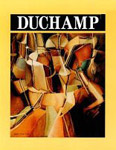 “Marcel Duchamp’s importance in twentieth-century art is comparable only to Picasso’s. Duchamp is one of those rare personalities whose influence directly altered the course of history, in this case art history, dividing it into a before and an after. Many artists have left their mark on the development of contemporary art, but Duchamp cleared and paved new paths that, without him, would have been impassable; even now many of those avenues are only beginning to be explored.” Page 5, Excerpt from “Great Modern Masters — Duchamp” General Editor: Jose Maria Faerna, Harry N. Abrams, Inc., Publishers, 1996
Duchamp Goes Beyond Painting
-
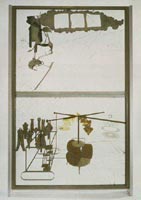 “Duchamp used paint as his medium until about 1913. during these early years, he diligently absorbed everything that painting as an artistic discipline had to offer. For example, when he encountered Cubism, he explored the style in such a peculiar and innovative way that other artists within the same movement misunderstood his efforts. By 1912, Duchamp already knew that painting interested him only as an intellectual tool, and his goal became to stretch the limits of painting, to transcend what he called “retinal” painting, namely a way of painting that dealt specifically with the representation and interpretation of sensorial data. Nowadays, it is clear that the majority of Duchamp’s Cubist paintings were mostly experiments and preliminary rehearsals for The Large Glass, the seminal work that consumed his attention between 1913 and 1923. Like all subsequent works by Duchamp, The Large Glass – the complete title of which, La mariee mise a nu par ses celibataires, meme, is best translated as “The Bride Stripped Bare by Her Bachelors, Even” – is notorious for being enigmatic and impenetrable. In reality, it is no more so than any other great work of art. It is part painting on glass and part fantastic machinery. The complicated mechanical works in The Large Glass obey a subverted and ironic logic: a series of outlandish devices, among which are a chocolate grinder and a water mill, enable a group of nine masculine archetypes (‘malic” molds or “bachelors” in Duchamp’s words) to slip off the dress of a bizarre feminine mechanical entity (“the Bride”) which, in the process, undergoes a boisterously lewd transformation. The machine, of course, produces no result, and its significance issues precisely from the comic disproportion between such enormous display and so slight an outcome. As well, The Large Glass is not exactly the machine itself, but rather, a very unlikely representation of it. Speaking of the nine bachelors, Duchamp once said that they were “the projection of the main points of a three-dimensional body.” This type of intellectually reductive operation is quite common throughout the artist’s oeuvre.” Page 5, Excerpt from “Great Modern Masters — Duchamp” General Editor: Jose Maria Faerna, Harry N. Abrams, Inc., Publishers, 1996

Bride Stripped Bare (by Thomas Girst)
The Bride Stripped Bare by Her Bachelors, Even, commonly referred to as “the Green Box,” is a green-flocked, self-hinged cardboard box containing one color plate and 93 facsimile reproductions of notes, drawings, and photographs of the painting of the same name. Marcel Duchamp, under the guise of his alter ego Rrose Sélavy, produced 320 of these green boxes (of which 20 are deluxe editions) in 1934. Both regular and deluxe editions are known as the Éditions Rrose Sélavy.
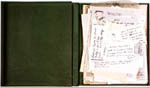 The Bride Stripped Bare by Her Bachelors, Even, commonly referred to as “the Green Box,” is a green-flocked, self-hinged cardboard box containing one color plate and 93 facsimile reproductions of notes, drawings, and photographs of the painting of the same name. Marcel Duchamp, under the guise of his alter ego Rrose Sélavy, produced 320 of these green boxes (of which 20 are deluxe editions) in 1934. Both regular and deluxe editions are known as the Éditions Rrose Sélavy.
 Michel Sanouillet, one of the first publishers of Duchamp’s writings, pointed out that “[t]he relationship of the notes to the Large Glass becomes clear if one bears in mind that the Glass, in Duchamp’s own words, is both ‘a wedding of mental and visual reactions’ and ‘an accumulation of ideas.’ The point is that ‘some ideas require a graphic language if they are not to be violated: this is my Glass. But a commentary [made up] of notes may be useful, like the captions that go with the photos in a Galeries Lafayette catalog. This is the raison d’être of my Box.'” (3)
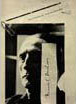
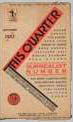
 Two years prior to Duchamp’s publication of the Green Box, some of his notes were published in the Surrealist issue of This Quarter. In 1957, The Readymade Press of New Haven, CT published Marcel Duchamp: From the Green Box with 25 notes translated by George Heard Hamilton (edition: 400). In 1959, Michel Sanouillet republished all of the 1934 Green Box notes in Marchand du Sel. Écrit de Marcel Duchamp. (Le Terrain Vague: Paris, 1959; regular edition: 2000) This was the first time the notes had been republished in full. Then in 1960, the first complete English translation by George Heard Hamilton became available as part of a typographic version of The Bride Stripped Bare by her Bachelors, Even by Richard Hamilton (edition: 1000).
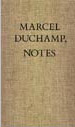
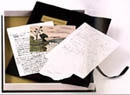 The notes in Duchamp’s 1934 Green Box were thought to be the only extant notes about the Large Glass. Duchamp, however, had more. Thirty-two years after publication of the Green Box, he produced “the White Box” or A l’Infinitif (NewYork: Cordier and Ekstrom, 1966; edition 150) which contained for the public startling additional notes. But these were not the last. A posthumously published volume edited by Paul Matisse and entitled Notes (Paris: Centre Georges Pompidou, 1980; edition: 1000) revealed even more additional “jottings” relating to the elements and mechanisms of The Bride Stripped Bare by Her Bachelors, Even.