



Duchampian News & Views
-

View A Nous La Liberte
September 16, 2008“A Nous La Liberte – Criterion Collection was an incredible movie! Both Jean Brlin and Inge Frss were amazing! The great cast includes Jean Brlin, Inge Frss, Francis Picabia, Marcel Duchamp, Man Ray…One of the all-time great comedy classics, Ren Clair’s Nous la Libert is a skillful satire of the industrial revolution and the blind quest for wealth. Deftly integrating his signature musical-comedy technique with pointed social criticism.”
read more... -
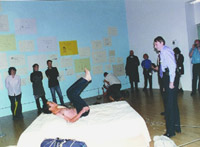
Duchamp’s urinal and Tracey Emin’s Bed
September 16, 2008 JJ Xi & Cai Yuan . Two Artists jump on Tracy Emin's Bed. Performance at Tate Britain, London, 1999 Image source "WHEN CHINESE performance artists Yuan Chai and Jian Jun Xi tried to urinate in a replica of Marcel Duchamp's famous latrine in the Tate Modern in 2000, their behaviour showed a distinct pattern. A year earlier, the duo had jumped up and down on the work of the unvictorious Turner Prize nominee, Tracey Emin. They called their performance Two Naked Men Jump Int.. read more... -

Why more Dadaism?
September 12, 2008“For nearly fifty years, since Pop Art began and dethroned the “high art” seriousness of Abstract Expressionism as a manifestation of elitism, the inheritance of Dadaism has ruled the art world. This philosophy, promulgated first 100 years ago by Marcel Duchamp and his colleagues, declares that art in the prior sense of a directed, purposeful activity separate from and “above” everyday reality, is an outmoded concept.”
read more... -
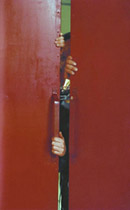
Jump And Piss
September 12, 2008“On Oct 24th,1999, at London’s Tate Gallery, the artists, JJ Xi
read more...
(b.1962) and Cai Yuan (b.1956) stripped down to their underpants before jumping on top of Emin’s bed and engaging in a pillow fight…Yet, this wasn’t conservative iconoclasm. What was at stake in the performance, Two Artists Jump on Tracey Emin’s Bed, was the horizon of the Duchampian readymade.” -
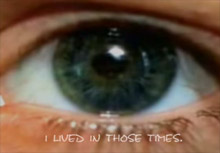
Epitaph, Poetry by Robert Desnos
September 12, 2008” In 1922 he published his first book, a collection of surrealistic aphorisms, with the title Rrose Selavy (based upon the name (pseudonym) of the popular French artist Marcel Duchamp).”
read more... -
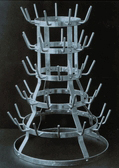
ARTISTIC LICENSE: Duchamp’s ‘Bottle Rack’ revisited
September 12, 2008“Duchamp purchased a common bottle-drying rack sometime in 1914 and brought it to his studio. Two years later, while traveling, he wrote to his sister and asked her to paint an inscription on the bottle rack because he had decided that it was sculpture ‘readymade.’ Unfortunately, she had already thrown it out.”
read more... -
Reasons That We’ll Always Have Paris
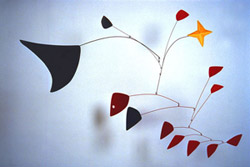
September 12, 2008“A young Calder arrived in Paris as a realist painter and illustrator; within seven years he had been transformed into a Surrealist sculptor whose playful ‘drawings in space’ were admired by Marcel
read more...
Duchamp, among others. ” Duchamp coined the term “mobile” for describing Calder’s moving sculptures. -
“MARCEL DUCHAMP : ‘ THE GREAT ARTIST OF TOMORROW WILL BE UNDERGROUND’
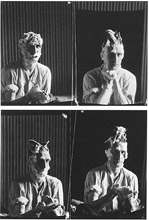
September 12, 2008Marcel Duchamp said, “Therefore I am inclined, after this examination of the past, to believe that the young artist of tomorrow will refuse to base his work as over-simplified as that of the ‘representative or non-representative’ dilemma. I am convinced that, like Alice in Wonderland, he will be led to pass through the looking-glass fo the retina, to reach a more profound expression.”
read more... -
Never mind the Pollocks
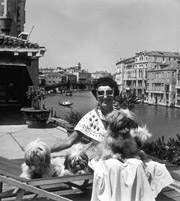
September 12, 2008“One day Pollock, Duchamp and Guggenheim had a row over a canvas she had commissioned for the foyer of her East Side townhouse in New York. At 20ft wide, it proved too big for the allotted space. Duchamp proposed cutting eight inches off one end. Pollock disappeared to get drunk, wandering back later into a party at Guggenheim’s apartment and peeing into her fire.”
read more...