



Duchampian News & Views
Somewhere Between Art and Life
Author : marcelduchamp_admin August 21, 2009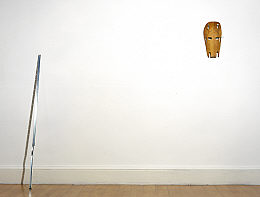 Martin, Boyce, Now I've got real worry (Mask and L-bar) 1998
Image Source
Martin, Boyce, Now I've got real worry (Mask and L-bar) 1998
Image Source
There are times at Venice when you feel Marcel Duchamp has a lot to answer for. The artist’s infamous urinal not only paved the way for the grand, imaginative gestures of, say, Robert Rauschenberg – whose scrap-iron sculptures are at the Peggy Guggenheim museum – but also for a slew of self-indulgent installation art much of which is currently taking up exhibition space in the city of Titian and Tintoretto.
The Scottish and Mexican pavilions prove that Duchamp’s legacy has not been wasted. In palaces either side of the square of Santa Maria Formosa, Martin Boyce and Teresa Margolles have produced visionary subversions of the found-object genre. Although concerned with radically different landscapes, the pair are flâneurs , adept at revealing the back stories of their own territories. Both conjure art out of matter that often slips beneath our radar – the clandestine, uncanny spirits that discreetly animate our everyday world.
Boyce, a 42-year-old sculptor based in Glasgow, opens his show with a path of stepping stones whose jagged course is mapped by dulled-gold, edge-crisped replicas of fallen autumn leaves. Above hangs a sculpture of plastic, interlocking, polygonal panels. These oblique, sail-like shapes have been the leitmotif of Boyce’s work since he saw them in a photograph of a pair of “concrete trees” made by the French Cubist sculptors Joël and Jan Martel for the 1925 Decorative Arts Exhibition in Paris. The Martels’ work nourished Boyce’s appetite for modernism. Since the mid-1990s, he had been making sculptures that played on design icons such as Arne Jacobsen’s Ant chair and the Eames brothers’ ESU storage unit. But the concrete trees’ “perfect collapse of architecture and nature” nudged his work beyond the urban interior.
Source