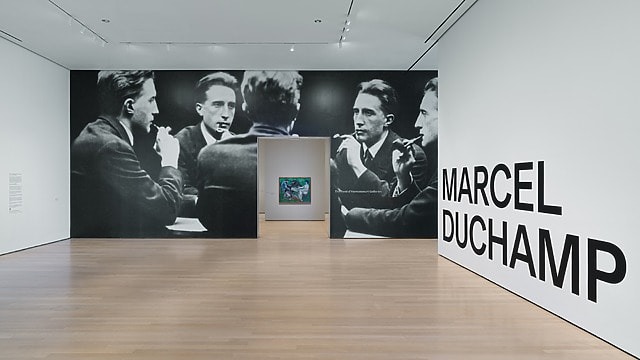

| Duchampian News & Reviews from institutions, scholars and fans
• DADA part two: Marcel Duchamp
by Angela, DLC Blog
|
"Everyone who hates art, or what art has come to symbolize in 'modern society' today and in history can look to Marcel Duchamp. This of course, is a contradictory statement that Duchamp would not approve of. His questions and art-from his submission of a bicycle wheel as an art piece (which is currently at the MOMA in New York), to his Mona Lisa with a moustache, and the cubist, 'Nude Descending a Staircase,' Duchamp's works are varied, layered, complicated, touching yet humorous." more |
• Art appreciator
by Agagooga, Balderdash
|
"Since the days of Duchamp and warhol, art can be understood in two ways: Art is a way of doing things, art is a way of seeing things." more |
• Marcel Duchamp Video Tribute-- Le Chaterie
by pinkup, iikki
|
"I have created a short video for the Vector Defenders
(Vector Defenders) project, by
OnClick studio (OnClick). It is a tribute to
the Dada artist Marcel Duchamp's visual experiments, and music has
been taken from the album Bailes Vespertinos. To be seen in Motion
section at iikki.com " more |
• Military Avoidance: Marcel Duchamp and the 'Jura-Paris Road'
by Kieran Lyons, The Tate
|
| Troop Distribution and Positions of the French Army), 1905, Detail of Paris. National Archive, Kew Image source |
"In 1905, the year of this War Office Report on French military
resources, Marcel Duchamp was drawn into the 'net' of military conscription that was
intended to incorporate every able-bodied twenty-one year old Frenchman into the national effort. Duchamp complied somewhat unwillingly but nevertheless managed to reduce his period of service
" more |
• "Symbiotaxiplasm" = Duchamp's "infra-thin" ?
by Thivai Abhor
|
| View Magazine, special issue, designed by Duchamp included his new concept of the "infra thin"Image source |
"Symbiotaxiplasm is a term conceived by the social science
philosopher Arthur Bentley (a contemporary of John Dewey, see Art As
Experience) that describes an action of interconnectedness...Perhaps
this is something similar to what Marcel Duchamp meant by the
infrathina poetic term describing the infinitely small difference
between two things." more |
• Duchamp said...
by Passionate Ornithology
|
".. ' since a three-dimensional object casts a two-dimensional
shadow, we should be able to imagine the unknown four-dimensional
object whose shadow we are. I for my part am fascinated by the search
for a one-dimensional object that casts no shadow at all.' by Octavio
Paz" more |
• John Cage playing chess with Joan La Barbara
by Uncertain Times
|
"Actually, Cage hadn't lost every single match with Duchamp. There
was one that he definitely won, after a fashion. It happened in
Toronto, in 1968. Cage had invited Duchamp and Teeny to be with him
on the stage. All they had to do was play chess as usual..." more |
• The Unholy Trinity
by Soma in Kinderland
|
"Do you know Rrose Sélavy? No? Humm… Eros, c'est la vie… arroser la vie…Rrose, my dear, is a
creation of three provocative artistic figures from 20th century's
early years.
Man Ray,
Marcel Duchamp and Francis Picabia were good friends with the same
sense of humour..." more |
• Yes, Duchamp's piece was a pivotal moment
by Wrinkled Weasel
|
"A while back, Roger Scruton, the philosopher and writer, wrote this piece on his very occasional blog: The literature of this industry is as empty as the neverending imitations of Duchamp's gesture. Nevertheless, it has left a residue of skepticism. If anything can
count as art, then art ceases to have a point. All that is left is the curious but unfounded fact that some people like looking at some things, others like looking at others." more |
• Marcel Duchamp Lived Here That Long???
by Stacy Horn
|
"I looked up the address when I got home and freaking Marcel Duchamp
lived there from 1942 until he died in 1968. How can that be? We had
him that long, and so close (to where I live I mean)?? I had no
idea. According to Wikipedia he died in France though, but did live
in a Greenwich Village studio for many years. So maybe he didn't die
here, but he lived here a long time and produced his last work of art
here, years after everyone thought he had stopped making art." more |
• Duchamp's 3 Stoppages Étalon
by Dingo on Raggit
|
"Many of the stories he tells just don't line up," Shearer says.
Consider Three Standard Stoppages, in the collection of the Museum of
Modern Art, a key early work. Toward the end of 1913, Duchamp said,
in his Paris studio, he cut three lengths of thread, each just under
one meter long, dropped them from a height of one meter, and affixed
the results on three separate canvases---a new standard of measure,
incorporating chance and randomness, for the new art of this
century." more |
• Agreement
between Proa and MAM-SP for Duchamp in Latin America
by Curator, Elena Filipovic
MAM – MUSEU DE ARTE MODERNA DE SÃO PAULO:
15 July - 21 September, 2008
FUNDACION PROA:
November 19, 2008 - February, 2009
"Two years after an intensive investigation and production, Fundación
Proa today shares with the MAM-SP the success obtained from the
critics and public for the exhibition Marcel Duchamp: a work that is
not a work "of art", inaugurated in São Paulo last July 15,
constituting the artist's largest individual show in Latin America."
more |
• The art factory and the death of the connoisseur
by Richard Feigen , The Art Newspaper
|
"In Duchamp's day the 'art world' was tiny and the initiates were
ready for a breakthroughfor new ideas and new media, for 'dada'and
the big money wasn't there. Once we accept that the artist's hand is
no longer necessary, only his idea, it's a short leap to market the
concept that beauty is not only no longer essential, it can even be
turned into a dirty, elitist' word." more |
• Duchamp's mystery
by Prisc , thisOtherEden
|
" He is famous. No doubt about it. He led the artists of his time to one of the greatest revolutions of all. He changed the whole idea of art, of what it is. And yet, was he actually laughing at his private joke? Laughing at those who followed him, believing they were following a new belief. Laughing that he had us all fooled, us who took his word. If it is true that it was all a lie,
Would it make a difference?" more |
• le duchamp (2008) by Rafael Rozendaal
by Cici Moss
• View A Nous La Liberte
by emailoptinlist89rhe
|
"A Nous La Liberte - Criterion Collection was an incredible movie!
Both Jean Brlin and Inge Frss were amazing! The great cast includes
Jean Brlin, Inge Frss, Francis Picabia, Marcel Duchamp, Man Ray...One
of the all-time great comedy classics, Ren Clair's Nous la Libert is
a skillful satire of the industrial revolution and the blind quest
for wealth. Deftly integrating his signature musical-comedy technique
with pointed social criticism." more |
• Duchamp's urinal and Tracey Emin's Bed
by Paul Dalgarno , Sunday Herald
|
JJ Xi & Cai Yuan . Two Artists jump on Tracy Emin's Bed.
Performance at Tate Britain, London, 1999
Image source |
"WHEN CHINESE performance artists Yuan Chai and Jian Jun Xi tried to
urinate in a replica of Marcel Duchamp's famous latrine in the Tate
Modern in 2000, their behaviour showed a distinct pattern. A year
earlier, the duo had jumped up and down on the work of the
unvictorious Turner Prize nominee, Tracey Emin. They called their
performance Two Naked Men Jump Into Tracey's Bed. Emin had called her
piece simply My Bed. Like Duchamp's latrine, the bed offered no easy
answers and provoked extreme, mostly negative, reactions..." more |
• Why more Dadaism?
by Charles Zigmund, Artdoxa
|
"For nearly fifty years, since Pop Art began and dethroned the "high
art" seriousness of Abstract Expressionism as a manifestation of
elitism, the inheritance of Dadaism has ruled the art world. This
philosophy, promulgated first 100 years ago by Marcel Duchamp and his
colleagues, declares that art in the prior sense of a directed,
purposeful activity separate from and "above" everyday reality, is an
outmoded concept." more |
• Jump And Piss
by Nadim Julien Samman, Art India
|
"As the team of JJ Xi and Cai Yuan wreaks havoc in the hallowed halls
of prestigious art institutions, Nadim Julien Samman tells us more
about the mischievous nature of their interventions."
Image source |
"On Oct 24th,1999, at London's Tate Gallery, the artists, JJ Xi
(b.1962) and Cai Yuan (b.1956) stripped down to their underpants
before jumping on top of Emin's bed and engaging in a pillow fight...Yet, this wasn't conservative iconoclasm. What was at stake in the
performance, Two Artists Jump on Tracey Emin's Bed, was the horizon
of the Duchampian readymade." more |
• Epitaph, Poetry by Robert Desnos
by DaniellaPirani, Poetry Visualized
|
" In 1922 he published his first book, a collection of surrealistic
aphorisms, with the title Rrose Selavy (based upon the name
(pseudonym) of the popular French artist Marcel Duchamp)." more |
• ARTISTIC LICENSE: Duchamp's 'Bottle Rack' revisited
by Mark Webber , theweekender.com
|
"Duchamp purchased a common bottle-drying rack sometime in 1914 and
brought it to his studio. Two years later, while traveling, he wrote
to his sister and asked her to paint an inscription on the bottle
rack because he had decided that it was sculpture 'readymade.'
Unfortunately, she had already thrown it out." more |
• Reasons That We'll Always Have Paris
by Karen Rosenberg , New York Times
|
ALEXANDER CALDER (American, 1898-1976) The Star, 1960 Polychrome sheet metal and steel wire, 35 3/4 x 53 3/4 x 17 5/8", University of Kentucky Art Museum
Image source |
"A young Calder arrived in Paris as a realist painter and illustrator; within seven years he had been transformed into a Surrealist sculptor whose playful 'drawings in space' were admired by Marcel
Duchamp, among others. " Duchamp coined the term "mobile" for describing Calder's moving sculptures. more |
• "MARCEL DUCHAMP : ' THE GREAT ARTIST OF TOMORROW WILL BE UNDERGROUND'
by Esthétique , Samedi
|
Marcel Duchamp said, "Therefore I am inclined, after this examination of the past, to believe that the young artist of tomorrow will refuse to base his work as over-simplified as that of the 'representative or non-representative' dilemma. I am convinced that, like Alice in Wonderland, he will be led to pass through the looking-glass fo the retina, to reach a more profound expression."
more |
• Never mind the Pollocks
by Stuart Jeffries, The Guardian (Hat tip : pollocksthebollocks.com)
|
"One day Pollock, Duchamp and Guggenheim had a row over a canvas she had commissioned for the foyer of her East Side townhouse in New York. At 20ft wide, it proved too big for the allotted space. Duchamp proposed cutting eight inches off one end. Pollock disappeared to get drunk, wandering back later into a party at Guggenheim's apartment
and peeing into her fire." more |
• Book art by Marcel Duchamp… by withhiddennoise
|
"In his designs for bookbindings and jackets, Duchamp often made user of the continuity between front and back: in the chess book L'Opposition et les cases conjuguées sont reconciliées, 1932; in the designs for Hebdomeros and Ubu, executed by Mary Reynolds, 1935..." more |
• The Anti-Retina Of Duchamp
Posted in Video, Avant Garde by mbumba(Hat tip: Where The Pieces Fall)
|
Marcel Duchamp videos... more |
• Painter to Poet: Dorothea Tanning
by Andréa Fernandes , Mental_Floss Blog
|
"In 1946, Tanning married Max Ernst in a double wedding with Man Ray
and Juliet Browner. Their crowd also included Peggy Guggenheim
(Ernst's third wife; Tanning was his fourth),
Marcel Duchamp, René
Magritte, Salvador
Dali, Pablo Picasso, Dylan Thomas, and Truman Capote." more |
• A creator needs only one enthusiast to justify him
by Artist Quote
|
Man Ray "met Alfred Stieglitz in 1913, and through Stieglitz's Gallery 291, he became acquainted with many of the most innovative artists of the time,
including the founder of the New York Dada movement, Marcel Duchamp. Man Ray and Duchamp remained close friends throughout their lives." more |
• A new look at Art and Play
by Caroline Armijo, Beyond Friendship Gate
|
"But after trying to share my graduate work with others...how could I
possibly capture all of the art created by these six amazing artists:
Marcel Duchamp, Alexander Calder, Jean Tinguely (my personal favorite), Claes Oldenburg, Elizabeth Murray and Joseph Cornell...Well, thanks to the magic of the Internet and widgets, I can create content which gives you a glimpse into the breadth of these artists' creative genius. Plus I am hoping that it won't become hopelessly outdated within a week." more |
• Muybridge as Modernist Muse
on PortlandArt.net
|
Eadweard Muybridge
Animal Locomotion, Plate 700, 1887
Collotype
Image source |
"Eadweard Muybridge understood that a single photograph was of little
use when you are trying to understand the movement of an subject.
Movement is inherently a function of moving through time and space.
Muybridge's genius was that the even though a single photograph could
only reveal a frozen moment in the movement of an object, a series of
photographs are able to reveal a much more accurate description of
movement...In Picasso and Duchamp's paintings, it is difficult to
tell if it is the subject or the object that is moving. " more |
• A Little Dust, to Give a Room Character
by Alice Elliott Dark, New York Times
|
"Several of the most influential modernist artists made much of dust.
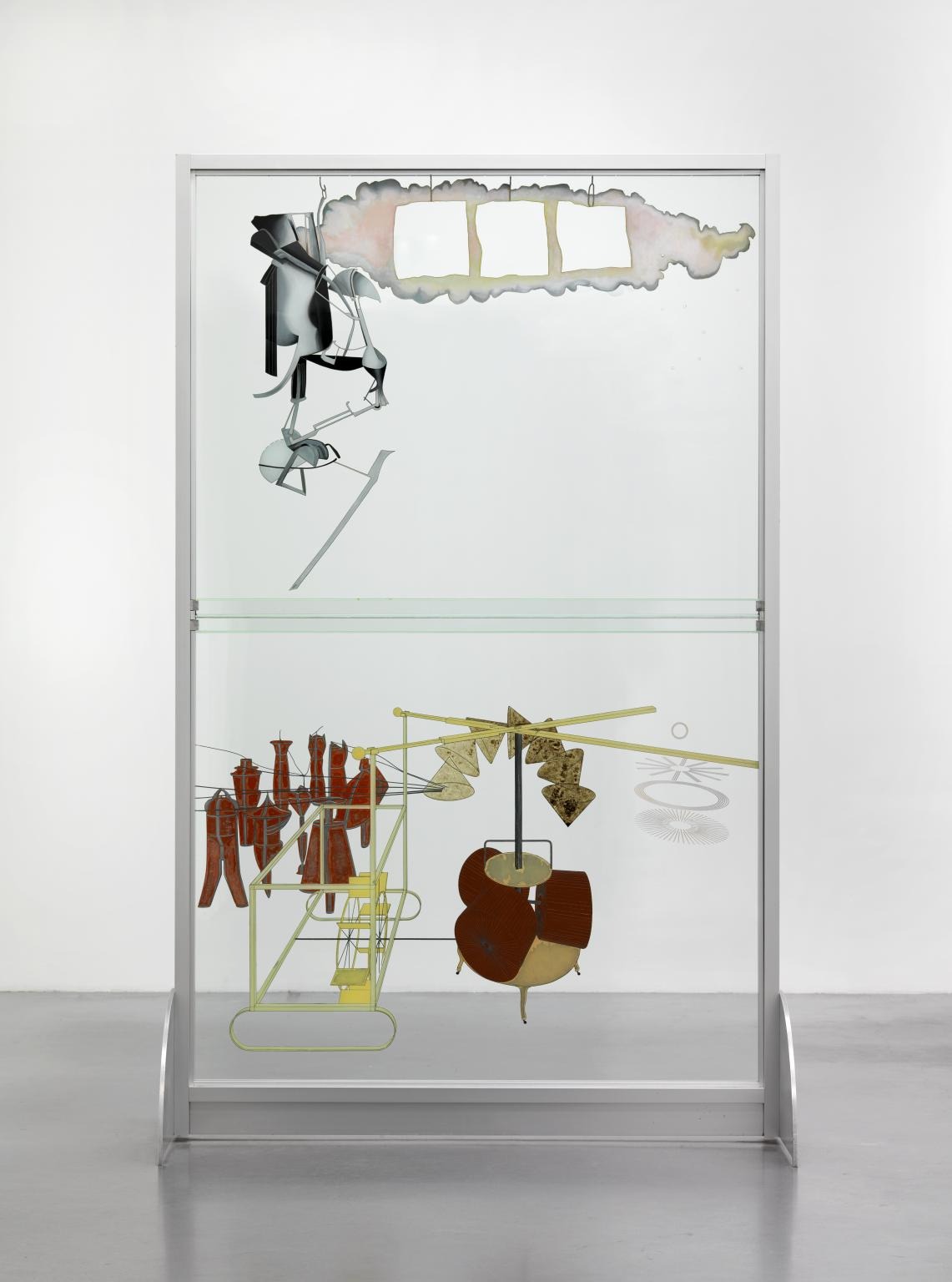
Marcel Duchamp grew it on plates of glass, and Man Ray photographed the results in a famous photo called "Dust Breeding." The glass was varnished and went on to become part of "The Bride Stripped Bare by Her Bachelors, Even," which you can see at the Philadelphia Museum of Art. "more |
• Joseph Kosuth
by Dzire's Wonderland
|
" A chair sits alongside a photograph of a chair and a dictionary
definition of the word chair. Perhaps all three are chairs, or codes
for one: a visual code, a verbal code, and a code in the language of
objects, that is, a chair of wood. But isn't this last chair simply .
. . a chair? Or, as Marcel Duchamp asked in his Bicycle Wheel of
1913, does the inclusion of an object in an artwork somehow change
it? "more |
• Marcel Duchamp
by Dario Rodighiero
|
"A tribute to Marcel Duchamp." more |
• Last work of surrealist Marcel Duchamp discovered
by Fiona Govan, , The Telegraph
|
"The existence of the fireplace had been rumored after sketches were found amongst Duchamp's papers following his death Photo: MNCA"
Image source |
"The last ever art work created by the influential French surrealist Marcel Duchamp has been discovered in an apartment in in northeastern Spain...
The artist is believed to be responsible for a corner fireplace built within the residence in the resort of Cadaques in Catalonia where he spent the final months before his death in October 1968. " more |
• Surrealist Art - Intro
by Aavey
|
"In 1941, Breton went to the United States, where he co-founded the
short-lived magazine VVV with
Max Ernst, Marcel Duchamp,
and the American artist David Hare. However, it was the American poet, Charles Henri Ford,
and his magazine View which offered Breton a channel for promoting Surrealism in the United States. The View special issue on Duchamp was crucial for the public understanding of Surrealism in America." more |
• Art object' stickers mysteriously appear, stirring discussion
by Steve Wideman , Post Crescent
|
"A sticker labels this pole at College Avenue and Oneida Street in downtown Appleton as "art object $100.00." The stickers mysteriously appeared throughout the business district. Post-Crescent photo by M.P. King"
Image source |
"No one knows where the dots came from, said Benjamin Shahin...'They
are everywhere downtown. You'll see light poles valued at $1,' Shahin said...
The stickers suggest a notion by the late French artist Marcel
Duchamp of "ready-made" art: that an artist can elevate an ordinary
object to the status of art simply by designating it as such, he said."
more |
• Original Copies: 'The Art of Appropriation' at MoMA
by JOHN GOODRICH , The New York Sun
|
Marcel Duchamp. (American, born France. 1887-1968). L.H.O.O.Q. Shaved. (1965). Playing card with colored ink on printed invitation,
8 1/4 x 5 3/8" (21 x 13.8 cm). Gift of Philip Johnson.
Image source |
"Nearby, Duchamp's "L.H.O.O.Q. Shaved" (1965) consists simply of a
playing-card image of the "Mona Lisa" mounted on a sheet signed by
the artist. The artist has left this portrait mustache-less, unlike
his infamous "L.H.O.O.Q." of nearly a half-century before."
Exhibition until November 10 2008 more |
• Chess from Duchamp to Damien Hirst
by Alastair Sooke, Telegraph.co.uk
|
Man Ray, Silver Chess Set, 1926, The Museum of Modern Art, New York
Image source |
"In 1927, Marcel Duchamp...married a young heiress called Lydie
Sarazin-Lavassor. The honeymoon did not go well. "Duchamp spent most
of the week studying chess problems," recalled the artist's close
friend Man Ray, "and his bride, in desperate retaliation, got up one
night when he was asleep and glued the chess pieces to the board." more |
• (Re)make it new
by William Bostwick , loveindustrialdesign.com
|
"Johnson and Duchamp turned springs and shovels into art objects by
renaming them, changing their context, casting them in new light. The
shovel never changed–just the way we looked at it. ..Duchamp's shovel
is still a shovel. John Gordon says that as a curator, he's ' looking
for craftsmanship and intellectual engagement. This might be an
object that appeals to me on a Christmas-gift level, but
museologically I look for something more. It's hard to do good things
that are witty because a one-liner isn't funny after a while.'" more |
• The genius of Duchamp?
Larry Evans on chess: Marcel Duchamp's vexing problem by Susan Polgar
|
"Many years ago [Francis] Neumann also submitted it to my column in
Chess Life, offering a reward of $15 to anyone who either could solve it or prove there was no possible solution. ' I have since subjected this problem to the most powerful computers and I am now convinced
that Duchamp has given us, in effect, a problem with no solution.'" more |
• Marcel Duchamp: Etant Donnes
by ruzik_tuzik, Huliq News
|
| Marcel Duchamp, Interior view of Etant donnés: 1° la chute d'eau / 2° le gaz d'éclairage (Given: 1. The Waterfall /2. The Illuminating Gas), 1946-1966
Image source |
"This is the first exhibition to examine the genesis, construction,
and reception of Etant donnes: 1° la chute d'eau, 2° le gaz
d'eclairage (Given: 1° The Waterfall, 2° The Illuminating Gas),
Marcel Duchamp's enigmatic final masterwork that was secretly
executed in New York during the last 20 years of his life and
discovered in his studio soon after his death in October 1968. The
exhibition will be on view from July 2009 to October 2009." more |
• Duchamp & The Indifferent Field of Possibilities
by Byron Caplan
|
"This segment is from my documentary on Dada titled, "Random Acts of Beauty: The Story of Dada." this segment examines Duchamp's interest in randomness and chance as compared to the Zurich Dadaists. It is a different take altogether." more |
• Duchamp & the Hatrack
by Byron Caplan
|
"This segment is from my documentary on the Dada movement titled,
'Random Acts of Beauty: The Story of Dada.' Here, Stephen C Foster
talks about Duchampian mind-games used to determine what qualifies as
art. " more |
• Ranking the greatest artworks of the twentieth century
by Patricia Cohen, International Herald Tribune
|
Marcel Duchamp. Nude Descending a Staircase, No. 2 (1912). Oil on canvas. 57 7/8" x 35 1/8". Philadelphia Museum of Art.
Image source |
"His [David Galenson] statistical approach has led to what he says is a
radically new interpretation of 20th-century art, one he is certain art
historians will hate. It is based in part on how frequently an illustration
of a work appears in textbooks.
'Demoiselles' came in at No. 1 with 28 illustrations....Marcel Duchamp's
1917 'Fountain' — a white urinal — was seventh with 18 illustrations, and
his 1912 painting 'Nude Descending a Staircase, No. 2' was eighth with 16." more |
• Photo
bomber "Art Interventionists"
by Monica Corcoran , LA Times
|
| Male photo bomber in the background of this photo intervens by making a mocking expression that upstages the three blonds Image source |
"Critics will say that photo bombing hardly constitutes 'art
intervention,' which is the intentional meddling into a pre-existing
piece of artwork or even an art venue, like a gallery or museum. (The
performance artist who took a hammer to Marcel Duchamp's famous
urinal -- titled 'Fountain' -- in Paris in 2006 and called it his own
'art' is a good example of an art interventionist. Same goes for an
artist who manages to sneak his work into a museum.) more |
• What is Kinetic Art?
Avant-Garde Art in Motion Challenges the Observer
by Brenda Ann Bur
|
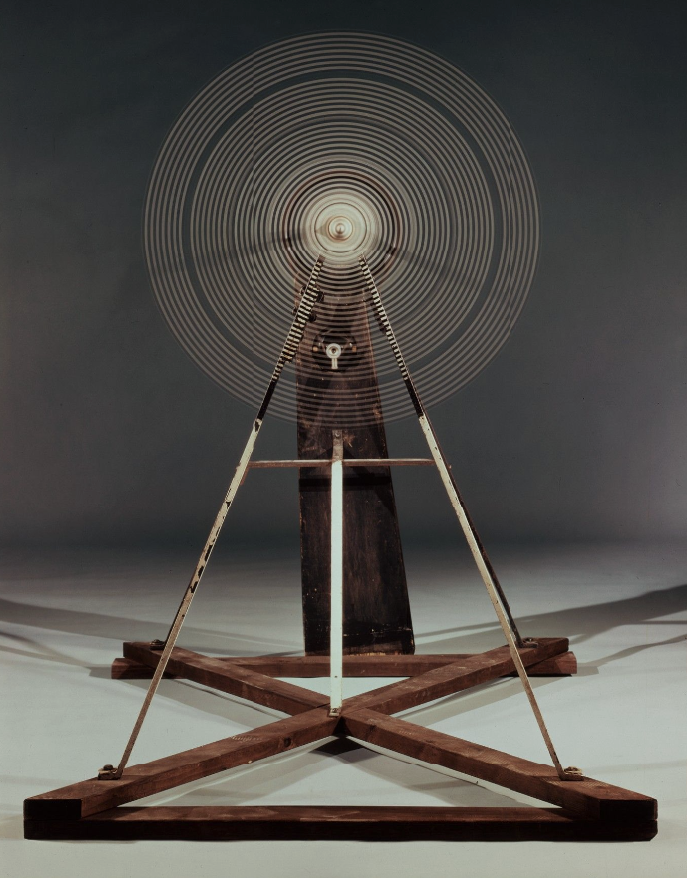
| From David Pescovitz of BoingBoing "Bicycle Wheel was the first of a class of objects that Duchamp
called his "readymades." He created twenty-one of them, all between
1915 and 1923." Image source |
"Marcel Duchamp was a French artist whose work is most often
associated with the Dadaist and Surrealist movements. Duchamp's
output had considerable influence on the development of post-World
War I Western art, and whose advice to modern art collectors helped
shape the tastes of the Western art world." more |
• Interview with Marcel Duchamp
by Gluon-Symmetry
|
"Marcel Duchamp was a French artist whose work is most often
associated with the Dadaist and Surrealist movements. Duchamp's
output had considerable influence on the development of post-World
War I Western art, and whose advice to modern art collectors helped
shape the tastes of the Western art world." more |
• Dreams That Money Can Buy
by zeno
|
The film " is a 1947 American experimental feature color film
written, produced, and directed by surrealist artist and dada
film-theorist Hans Richter. Each of the seven surreal dream sequences
in the diegesis is in fact the creation of a contemporary avant-garde
and/or surrealist artist, as follows: Desire Max Ernst
(Director/Writer);...Ruth, Roses and Revolvers Man Ray
(Director/Writer); Discs Marcel Duchamp (Writer) " more |
• Marcel Duchamp's Birthday today : July 28, 1887
• 'Erratum Musical'
by Lina Dzuverovic
|
| "The directions behind Marcel Duchamp's Erratum Musical are
deceptively simple. Each note on a given keyboard is played only
once, the order of the notes is determined by random draw, and there
are no instructions for how the notes are to be played. A Dadaist
joke? On the contrary, it yields intricate music and a primer for
discussing how sound relates to emotion." Image source |
"The practice of cutting-up, appropriating and repurposing existing
content in the creation of new artworks was central to 20th century
artistic practice. From Marcel Duchamp's 'Erratum Musical' (1913)
which spliced together dictionary definitions of the word 'imprimer'
with a score composed from notes pulled out of a hat..." more |
• Happy Birthday Berenice Abbott
BERENICE ABBOTT (1898–1991)
"Berenice Abbott can be considered the photographer of New York City.
A revolutionary documentary photographer, Abbott was born in
Springfield, Ohio, in 1898, and studied for one year at Ohio State
University, Columbus, before moving to New York in 1918 to study
sculpture. While in New York, Abbott met Marcel Duchamp and Man
Ray, two of the founders of the Dada movement"" more |
• Duchamp in Buenos Aries : Exhibition
"De la estadía porteña de nueve meses de Marcel Duchamp es
relativamente poco lo que se sabe y gracias a la creación de unas
pocas obras y a una decena de cartas."" more
|
• Marcel Duchamp: A work that is not a work "of art"
by Lee Wells
MAM – MUSEU DE ARTE MODERNA DE SÃO PAULO
Curator: Elena Filipovic
15 July - 21 September
"On the day marking its 60th birthday, July 15 (Tuesday), the Modern
Art Museum of São Paulo presents Marcel Duchamp: A work that is not a
work 'of art '. The exhibition takes its title from a question that
Marcel Duchamp wrote down one day in 1913: "Can one make works that
are not 'of art'?" more
|
• Picabia, Man Ray, Duchamp, des hEROS
by L. Brandon Krall
|
| "Man Ray, The Rope Dancer Accompanies Herself with Her
Shadows, 1916. Oil on Canvas, 132.1 x 186.4 cm. Courtesy of the
Museum of Modern Art, New York. © ADAGP, Paris and DACS, London, 2008."Image source |
"Review: Duchamp, Man Ray, Picabia was on view at the Tate Modern,
London in May. It traveled to the Museu Nacional d'Art de Catalunya,
Barcelona, where is on view from June 19 to September 21." more
|
• Elsa Schiaparelli, Surrealist Star
by David Motta
"Elsa Schiaparelli was an influential Italian fashion designer. Along
with Coco Chanel, she dominated fashion between the two World Wars.
Starting with knitwear, her designs were heavily influenced by
Surrealists like her collaborator Salvador Dali...Elsa began working
for Gaby [Picabia, ex-wife of French Dadaist artist Francis
Picabia] who introduced her to artists such as Marcel Duchamp and
Man Ray." more
|
• Machinima and Up and Coming
by The Recycled Cinema
"Most of my reading and writing right now is concerned with how
Surrealists theorized found objects. The principal figures I'm
looking at, Joseph Cornell and Marcel Duchamp were not officially
inaugurated by Andre Breton into the Surrealist group but made some
of the most interesting contributions to found object art with their
assemblages and readymades." more
|
• 'ALL ARTISTS ARE NOT CHESS PLAYERS" :
Allan Savage on Duchamp, Man Ray, Picabia
by Michael Leonard
|
1911. Oil on canvas 108 x 101 cm. The Philadelphia Museum of Art, Philadelphia, PA, USA.
Image source |
"For Marcel Duchamp, chess was almost everything.
As his friend, the author Henri-Pierre Roché,
noted: "He needed a good chess game like a baby
needs his bottle." It featured throughout his art
career, from his early painting Portrait of Chess
Players (1911) to Reunion, the performance/chess
game he staged with John Cage in 1968 on an
electronically prepared board." more
|
• Jeu d'échecs avec Marcel Duchamp
by harry wanders
"This film records an in-depth interview with Duchamp which took
place five years before his death, at the time of his first ever
one-man show (at the Pasadena Art Museum). It records for posterity
Duchamp talking about his life, his ideas on art, why he chose to
continue living in America after fleeing France in 1915, and why he
virtually abandoned his work as an artist in 1923." more
|
• Machinima
and Up and Coming
work by The Recycled Cinema
"Most of my reading and writing right now is concerned with how
Surrealists theorized found objects. The principal figures I'm
looking at, Joseph Cornell and Marcel Duchamp were not officially
inaugurated by Andre Breton into the Surrealist group but made some
of the most interesting contributions to found object art with their
assemblages and readymades." more
|
• Davy between painting, photography
by Alex Supartono, Contributor, Jakarta
|
| Photo credit for Duchamp's "Fountain" 1917, was given to Alfred
Steiglitz ...but there is no negative or other record other than
Steiglitz's mention of it in a letter. Image source |
"In his letter to Alfred Steiglitz -- the father of American
photography -- Marcel Duchamp wrote: "You know exactly how I feel
about photography. I would like to see it make people despise
painting until something else will make photography unbearable." The
letter is dated May 22, 1922." more
|
• Duchamp: "Sixteen Miles of String" (1942)
Posted by Wrong
"Duchamp bought 16 miles of string, of which only one mile was used,
to prepare an entanglement in which the visitor experienced
difficulties in finding his way to the paintings, a metaphor for the
difficulties which the layman often encounters in the attempt to
understand modern painting"
more
|
• Ducham en Barcelona
by A-Desk Media
"See video of new "Duchamp, Man Ray, Picabia" exhibition in Spain more
|
• Duchamp, Man Ray, Picabia Exhibit at Museo Nacional D'Art de Catalunya
by Art Knowledge News
"BARCELONA - This exhibition aims to chart the artistic and personal
relationships of three of the great figures in early
twentieth-century art, Marcel Duchamp, Man Ray and Francis Picabia.
Together they created the Dada movement in New York during the First
World War, and, unusually within the history of modern art, they
remained friends, with periods of varying intensity, throughout their
lives. On view 26 June through 21 September, 2008." Visit Museo Nacional D'Art de Catalunya at : http://www.mnac.es
more
|
• Wee exhibit, big scandal
by Angela Bennie
|
"First turn... a replica of Mercel Duchamp's original
'readymade' Bicycle Wheel."
Image source |
"Which is perhaps why Carolyn Christov-Bakargiev, the curator of the
2008 Biennale of Sydney, has placed Duchamp's Bicycle Wheel right at
the centre of her huge line-up of contemporary art in this year's
Biennale program, to which she has attached the slogan "Revolution -
Forms that Turn" as her overriding theme. 'A revolution is a turn and
a return,' she says. ' It is also a sudden shift in perspective, a
turning of perspectives, which is what Duchamp has done. So with this
Biennale I am opening up the meaning of the word revolution.'" more
|
• Marsden Hartley exhibit at Amon Carter shows darker vision of the West
By CHARLES DEE MITCHELL
|
"Painting, Number 5," by Marsden Hartley, 1914-5, oil on canvas, 39 1/2 by 31 3/4 inches, Whitney Museum of American Art Image source |
"[Marsden] Hartley returned to New York City in 1919, where he became
an unlikely member of the Société Anonyme, the avant-garde group
headed by Marcel Duchamp, Man Ray and Katherine Dreier. Hartley was
attracted to the freedom of the group, but he was at heart a much
more traditional artist and he lasted only seven months." more
|
• PRIX MARCEL DUCHAMP: A COLLECTORS' PRIZE
By ArtSlant team
|
| On June 24, 2008, the exhibition of Tatiana Trouvé, the
winner of the 2007 Prix Marcel Duchanp, opens at the Centre Pompidou. Image source |
"The Marcel Duchamp Prize was created in 2000 by the ADIAF,
(Association for the international distribution of French art), the
largest group of private and amateur contemporary art collectors in
France, as an initiative, amongst others, for promoting French
artists internationally. Its aim is to encourage all new art forms
that stimulate contemporary creati | |